Ships from our USA and CANADA stock — no extra duties or import fees for US and Canadian customers


Why the Resistor Trick Fails on GM Passlock
Search for a GM Passlock fix, and it’s worth noting up front that plenty of people say “Passlock” when they actually have PassKey, and that Passlock 1, 2 and 3 all work on the same principle anyway, and you’ll find the same advice on every forum: cut the yellow wire at the steering column, solder in a 2,200-ohm resistor, run the relearn, drive away for six dollars. It’s the most repeated fix on the internet, and it does work: sometimes, for a while.
It’s also the reason a lot of people end up stranded a second time, further from home and more frustrated than the first. Here’s what the resistor is actually doing, why it fails, and what the whole exercise tends to cost once you add it up.
What the Resistor Trick Actually Does
Passlock doesn’t read anything in your key. A magnet in the ignition lock cylinder rotates past a Hall-effect sensor, and that sensor puts a reference voltage on a signal wire, usually yellow, running to the Body Control Module. The BCM compares that voltage to a value it has stored. Land within roughly 5–10% of it and the BCM tells the PCM to let the engine run. Miss it and the injectors are shut down, which is why the engine fires and then dies a second or two later. On some vehicles the fuel pump and the starter motor are cut as well, but disabling the injectors is what nearly all of these systems have in common.
The resistor trick cuts that yellow wire and substitutes a fixed resistor to ground in place of the sensor. You’re feeding the BCM a permanent, unchanging voltage instead of the one the lock cylinder was producing. If that value is close enough to what the BCM already has stored, or if you run a relearn so the BCM adopts the new value, the check passes and the truck starts.
So far, so good. The problem is what that does and doesn’t address.
Failure 1: 2,200 Ohms Is a Guess
There’s nothing magic about 2,200 ohms. It’s simply a value that happens to land in the workable range, and it got repeated until it became gospel. The usable window is wide, roughly 500 to 10,000 ohms is commonly cited, but the value that matters is the one your BCM already has stored, which depends on the specific magnet in your specific cylinder.
One well-circulated estimate puts the odds of 2,200 ohms happening to match a given vehicle at around 1 in 20. Everyone else has to run the relearn to force the BCM to accept the new value, which is fine, until the BCM loses it.
Failure 2: The Relearn Is Not Permanent
This is the one that catches people out, and it’s the reason the trick has a reputation for working brilliantly for six months and then quitting.
The stored Passlock value can be lost whenever the BCM loses power. That includes disconnecting the battery, letting the battery go completely flat, and in some cases pulling a BCM fuse. When it goes, the resistor you soldered in six months ago is suddenly an unrecognized value again, and you’re back to a no-start, except now the original sensor is cut out of the circuit too.
That is exactly what happened to one of our customers, Dale, who disconnected the battery on his 1999 Suburban before a three-month trip, came home, reconnected it, and found the truck dead with the SECURITY light staring at him. He’d already tried the resistor route. The system wouldn’t accept and relearn the code.
And the relearn itself is not a quick job: it’s three full cycles of key-on, wait for the light to go out, key-off, wait five seconds. Ten minutes each, thirty minutes total, uninterrupted. Open a door or press a button mid-cycle and the timer restarts. Doing that in a parking lot is nobody’s idea of a roadside fix.
Failure 3: It Only Fixes One Possible Cause
A resistor spliced in at the steering column defeats the sensor reading. It does nothing about anything downstream of that splice.
If the real fault is a corroded connector, a chafed wire, or a poor ground somewhere between the column and the BCM, or the Security Module itself (TDM), that fault is still there after you’ve installed the resistor. You’ve just changed what’s feeding the bad connection. Wiring problems are a genuinely common cause of Passlock trouble, because added resistance anywhere in that harness shifts the reference voltage out of tolerance the same way a failing sensor does. The resistor fix can’t tell the difference, and neither can you until it doesn’t work.
It also doesn’t touch other security-related faults: a mismatch between modules, for instance, is a different problem entirely and won’t respond to a resistor at all.
These are the kinds of issues a proper Passlock permanent bypass is built to handle instead of a soldered-in resistor.
Failure 4: It Doesn’t Survive the Conditions That Caused the Problem
Passlock faults are famously intermittent and weather-dependent. Temperature swings change the physical gap between magnet and sensor; low battery voltage drags the whole reference down. Our customer Stephan described this precisely on his Impala: it started on hot, humid days, disappeared when things cooled off, then came back worse the following summer.
A fixed resistor is not more stable than a sensor and the same low-voltage and harness-resistance conditions or faulty security module that pushed the original reading out of tolerance can still push a resistor-derived reading out of tolerance, and you’ve now removed your ability to diagnose the original fault.
The Cost Nobody Adds Up
The resistor itself is a few dollars. The trouble is what usually comes before and after it.
- A new battery, bought on the theory that the no-start is electrical. Our customer Regina spent this money on her Oldsmobile before learning it wasn’t the battery
- Shop diagnostic time, often more than once, because the fault is intermittent and won’t reproduce on demand
- Tow bills each time it strands you
- The parts-swap path: figures commonly quoted run to a few hundred dollars for an ignition lock and considerably more for a TDM or BCM, before labor
- Dealer quotes around $2,000 for a full theft-system replacement, which come up over and over in owner reports
Scott, who runs a 2000 Buick Century, put it plainly: “After a lot of messing around with so-called fixes and resistors, not to mention shop bills, I purchased a NEWROCKIES module.” The resistor was not the beginning of his repair. It was one stop on the way.
The Deeper Problem With Replacing Parts
Even the “proper” dealership repair has a flaw. Passlock’s Hall-effect sensors failed at a high rate. The sensor can’t be replaced on its own either: it’s part of the lock cylinder housing, so the whole assembly goes.
Which means a factory-correct repair puts the identical design back in your car, with the identical failure mode, and starts the clock over. Dale summed it up better than we could: “Swapping out a defective system with the same defective engineering is no answer.”
What a Full Bypass Does Differently
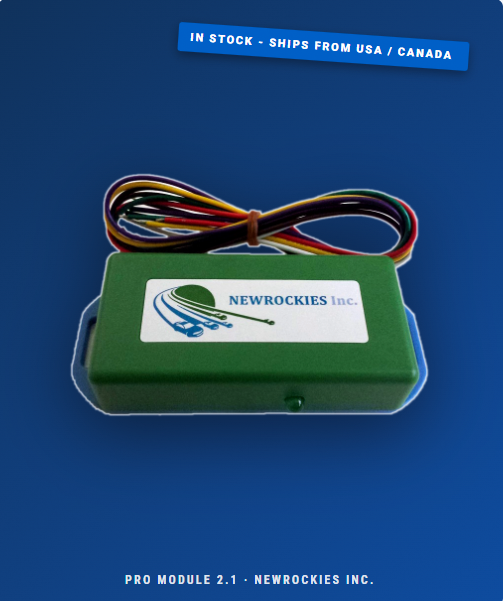
The distinction that matters is where the intervention happens. A resistor tries to make the security check pass by feeding it a plausible answer, and it stays at the mercy of that check, and of whatever the BCM remembers. The NEWROCKIES PRO Module is wired in at the theft module or BCM connector for your specific platform and either bypasses the module completely and permanently or it works dynamically with it to remove the security system’s ability to shut down your injectors, your fuel pump, or your starter.
No sensor, pellet, or transponder or security module left in the loop to drift out of tolerance or stop working on a cold morning. And it works across all of GM’s systems: VATS, PassKey 1, PassKey 2, PassKey 3, Passlock 1, Passlock 2, rather than only the one the forum thread happened to be about.
If you’re not yet certain which system your vehicle uses, start with our guide to identifying your GM security system.
If you already know, find your make, model and year in the installation guides for the exact connector and wire colors, or read more about the permanent Passlock bypass itself.