Ships from our USA and CANADA stock — no extra duties or import fees for US and Canadian customers

Which GM Security System Do You Have? VATS, PassKey or Passlock
If your security light is on and your GM won’t start, the single most useful thing you can do before spending a dollar is work out which anti-theft system you actually have. GM used several completely different designs between 1986 and the late 2000s, and they fail in different ways, live in different places, and are diagnosed with different tools. Guess wrong and you’ll replace a part that was never the problem.
This guide walks you through identifying your system three ways: by your key, by your symptom, and by your model year, and points you to the right wiring instructions once you know.
Method 1: Look at Your Key
Your key tells you most of what you need to know, and it takes ten seconds.
- Black pellet visible in the middle of the key blade, with a thin metal edge running along the key. You have VATS or PassKey I/II. The pellet is a resistor.
- Plain double-sided metal key, no chip, no pellet, no markings on the shaft. You have Passlock. The security lives in the lock cylinder, not the key.
- Thick plastic head with “PK3” stamped on the shoulder or shank. You have PassKey III. There’s a transponder chip hidden under the rubber cover.
That single check usually settles it. If the key is worn to the point where the markings are gone, keep reading.
Method 2: Match Your Symptom
Each system disables a different part of the vehicle, which produces a distinctly different failure. None of them kill spark.
It cranks, starts, then dies a second or two later
This is the classic anti-theft fingerprint, and it points at VATS, PassKey, or Passlock. The engine is allowed to fire, then the computer cuts fuel once it fails the security check. In the overwhelming majority of cases, across all of these systems, what actually gets disabled is the fuel injectors. Some vehicles also cut the fuel pump, and some also disable the starter motor, but the injectors are the common thread.
It cranks but never fires at all
Also consistent with the security system on some systems, but this is the symptom most likely to be something else entirely: fuel pump, crank sensor, ignition module. Check whether the security light is flashing before you assume anti-theft.
The starter is completely dead
On the original 1986–88 VATS Corvette system, or on other PassKey and VATS systems, a failed check disables the starter outright. On Passlock, a dead starter is usually not the security system, with one exception: repeated failed attempts can trip a lockout timer that temporarily disables the starter circuit, which usually clears by pulling the relevant fuse or relay, or disconnecting battery power. Still, on some vehicles, Passlock also disables the starter right away.
It starts fine after a 10-minute wait
This is the tell almost every customer describes for Passlock or Passkey 3 (NOT Passkey 1 or Passkey 2 or VATS). On those systems, the 10-minute wait isn’t the car “cooling off”. It’s the security system running its learn timer. If waiting 10 minutes reliably gets you started, you are looking at a security fault, not a mechanical one.
Method 3: Check the Model Year
Be careful with this one. There is no hard line anywhere in GM’s history. The model year is the weakest of the three methods, and we’re including it only as a rough sanity check on what you found from the key and the symptoms.
GM never made a clean switch from one system to the next. Some PassKey vehicles ran well into the 2000s, long after Passlock had appeared. Some Passlock vehicles started earlier than the commonly quoted dates. Two cars built in the same model year, from the same division, can carry entirely different hardware depending on the body style, the plant, and where in the production run they were built. Anyone who tells you “all 1999s have X” is guessing.
The Pontiac Grand Prix is the classic illustration. One nameplate, three eras, three completely different places to put your hands, but all PassKey. It never switched to Passlock:
- 1994–1996: at the Theft Deterrent Module, mounted backwards on a bracket behind the glovebox on the passenger side.
- 1997–2003: at the Body Control Module, under the dash on the left side by the parking brake pedal.
- 2000–2003: at the PCM/ECM instead, out in the engine compartment inside the air cleaner assembly.
Note that the last two overlap. A 2001 Grand Prix appears in both ranges. That isn’t a mistake in our guides. It’s two different types of installation for 2000-2003. This is exactly why the model year alone can’t tell you what you’re dealing with, and why it pays to look your specific vehicle up rather than assume.
With that firmly in mind, the broad ordering was:
- VATS (Vehicle Anti-Theft System): appeared first, in the mid-1980s, starting on the Corvette and spreading across the lineup. Resistor pellet in the key. The earliest version had no relearn capability at all.
- PassKey I and II: the same resistor-pellet concept under a more marketing-friendly name. These ran through the 1990s and, on some vehicles, well into the 2000s. Unlike the earliest VATS, these do have a relearn feature.
- Passlock: arrived in the mid-1990s and became widespread on trucks and cars over the following years, though it never fully displaced PassKey. No chip, pellet, or resistor in the key at all.
- PassKey III (PK3): transponder in the key head, introduced as GM moved away from Passlock’s reliability problems, and overlapping with both of the systems before it.
How Each One Actually Works
VATS / PassKey I and II: the resistor pellet
There are 15 possible key codes, each a specific resistance value from roughly 402 ohms up to about 11,800 ohms, with a tolerance of around ±10%. Contacts in the lock cylinder read the pellet’s resistance and pass it to the theft deterrent module (TDM). The module compares it to what it expects; if it matches, it partially grounds a reference voltage line back to the PCM, and the PCM keeps the injectors firing. If the module never sees that voltage drop, fuel gets cut and the engine dies seconds after starting.
The weak points are mechanical and predictable: the pellet wears, the contacts in the cylinder corrode, the TDM itself (very common point of failure), the connectors, and the two small wires running down the steering column from the lock cylinder break from years of turning.
Passlock: the magnet and Hall-effect sensor
Passlock threw the key out of the equation entirely. GM’s reasoning: if the lock cylinder turned, an authorized key must have turned it. A magnet mounted in the cylinder rotates past a Hall-effect sensor in the housing, and the resulting reference voltage goes to the BCM. If that voltage lands within roughly 5–10% of the value the BCM has stored, the BCM signals the PCM and the engine keeps running. Outside tolerance, the injectors are shut down, and on some vehicles the fuel pump and starter as well.
A note on “Passlock 1, 2 and 3.” You’ll see these labels used everywhere: by owners, by shops, and inconsistently by GM itself. There is a great deal of confusion around them, and plenty of people use “Passlock” when what they actually have is a PassKey system. For practical purposes it doesn’t matter much: whether yours gets called Passlock, Passlock 1, Passlock 2 or Passlock 3, the operating principle is the same in all cases: a magnet and a Hall-effect sensor in the lock cylinder producing a reference voltage that a control module checks against a stored value. The wiring location changes; the concept doesn’t. So don’t get stuck trying to pin down which number you have.
Different magnets produce different voltages, which is what makes cylinders non-interchangeable without a relearn. And because it’s a voltage-based check, anything that drags the reference voltage around causes false failures: a weak battery, extreme heat or cold changing the physical gap between magnet and sensor, or frayed and worn wiring adding resistance to the harness. That’s exactly why so many Passlock failures are intermittent and weather-dependent: they show up on hot days or cold mornings and vanish by afternoon.
PassKey III: the transponder
A transmitter ring around the lock cylinder interrogates a transponder chip in the key head; the chip answers with a coded message. Correct answer, the module tells the PCM to enable the engine. Wrong answer or no answer, the vehicle may start and then stall within seconds. A steady light for about two seconds is normal; flashing once per second indicates a fault, twice per second an invalid key.
One practical consequence: you cannot test PassKey III with an ohmmeter the way you can with a resistor-pellet system. It needs a scan tool.
Reading the Security Light
The dashboard light itself carries information, and the pattern is worth noting before you touch anything.
- Solid light for roughly two seconds at key-on, then out: normal self-test. The system is happy.
- Solid light that stays on while driving: a fault is stored, but the system is currently letting the engine run. This is often the warning stage before a hard no-start.
- Flashing once per second: on PassKey III, this indicates a system fault.
- Flashing twice per second: on PassKey III, this indicates an invalid or unrecognised key.
- Flashing with a no-start: the security system is actively refusing to allow the engine to run. On resistor-pellet systems this means the module isn’t getting the signal it wants from the lock cylinder, or the module itself has failed.
- Light goes out after about ten minutes: that’s the learn timer completing, not the fault clearing.
Where the Module Lives
This is the part that varies most, and it’s why there’s no single universal answer. On many resistor-pellet cars the TDM sits behind the glovebox on the passenger side; on some full-size RWD platforms the theft function is folded into a control module in the trunk. On Passlock vehicles the control moved several times across model years: early cars handled it in the instrument panel cluster (IPC), later ones in the Body Control Module. Our installation guides list the exact location and connector for each platform, which is the reliable way to find yours.
Why the Diagnosis Matters UNLESS you Buy a Full Bypass
Two reasons. First, the repair path is completely different: a resistor-pellet fault might be broken column wiring, while a Passlock fault is usually the lock cylinder housing, and the Hall-effect sensor inside it can’t be replaced separately, so the whole housing goes. Second, the parts add up fast. Typical figures we see quoted are in the range of a few hundred dollars for an ignition lock and considerably more for a TDM or BCM, before labor, and dealer quotes north of $2,000 come up repeatedly in owner reports.
And there’s a deeper problem with the parts-replacement route: you’re swapping a defective design for the same defective design. Passlock’s Hall-effect sensors had a high enough failure rate that GM moved on from the system entirely. Replacing yours resets the clock; it doesn’t change the outcome.
What a Full Bypass Does Instead
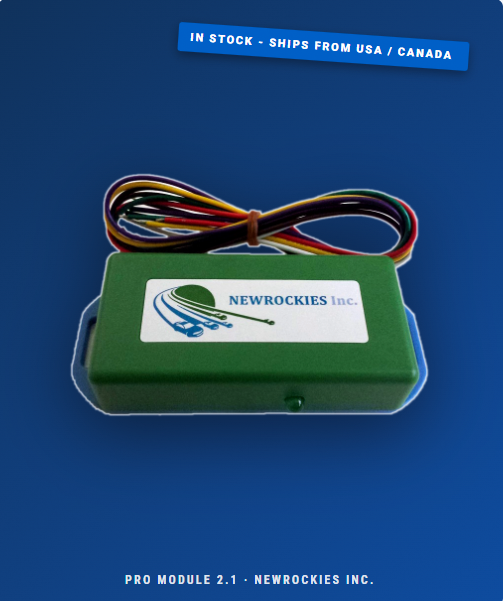
The NEWROCKIES PRO Module works on all of these systems: VATS, PassKey, Passlock and PassKey III. Rather than trying to make the original security check pass, it removes the security system’s ability to interfere with starting at all, wired in at the module connector for your specific platform. No pellet to wear, no Hall sensor to drift, no transponder to lose sync, and, in many cases, no Security module anymore.
You can find your vehicle in the installation guides for the exact module location, connector and wire colors, or read more about how the permanent Passlock bypass works.